Sustainability considerations are integrated into IndianOil’s long-term investment priorities, infrastructure development plans and operational practices. During the year, we continued to progress initiatives across renewable energy, biofuels, green hydrogen, sustainable aviation fuel and circularity, while maintaining focus on reliability, scale and operational resilience across the value chain. We remain committed to achieving Net-Zero operational emissions by 2046.
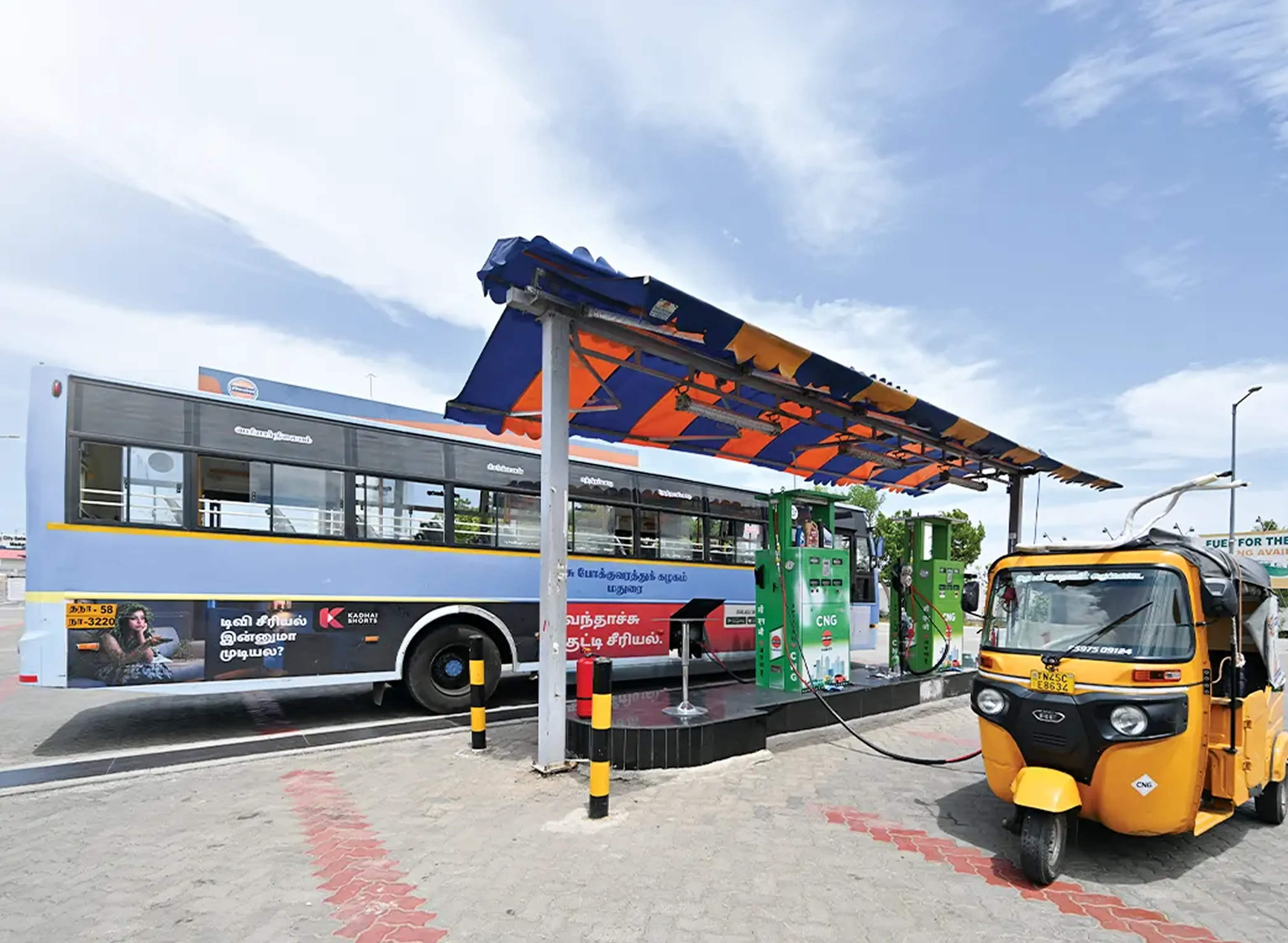
CNG facility at Retail Outlet, Tamil Nadu
SUSTAINABILITY PHILOSOPHY AND GOVERNANCE
Environmental and climate-related priorities are reviewed through structured governance mechanisms at both the corporate and operational levels. The Corporate Climate Ambition Committee (CCAC) and the Inter-Divisional ESG Committee continue to oversee the implementation and monitoring of sustainability initiatives across businesses. ESG performance and HSE-related matters are periodically reviewed at Unit, Division and Corporate levels, including through oversight by the Board.
IndianOil continues to institutionalise environmental and energy management practices across operational locations through certified management systems, monitoring mechanisms and process controls.
Key Certifications Across Operational Locations
- ISO 14001 Environmental Management Systems
- ISO 45001 Occupational Health & Safety Management Systems
- ISO 14064 verification for GHG quantification and reporting across refineries and petrochemical plants
- ISO 50001 Energy Management Systems across refineries, LPG bottling plants and major pipeline installations
Sustainability Awards & Recognition


SUSTAINABILITY REPORT
IndianOil’s Sustainability Report provides a comprehensive account of the Company’s Environmental, Social and Governance (ESG) performance, policies and priorities. The report presents IndianOil’s approach to integrating sustainability considerations into business planning, governance, operations and risk management, while outlining progress across material ESG topics and the actions being taken towards achieving the Company’s Net-Zero operational emissions target by 2046. It includes disclosures on climate governance, greenhouse gas emissions, climate-related risks and opportunities, resource efficiency, natural capital management and progress against sustainability commitments and targets.




The report has been prepared in accordance with globally recognised reporting frameworks and standards, including the Global Reporting Initiative (GRI) Standards, International Financial Reporting Standards (IFRS) Sustainability Disclosure Standards and the Taskforce on Nature-related Financial Disclosures (TNFD). It is also aligned with the United Nations Sustainable Development Goals and the principles of the United Nations Global Compact. The report has been independently assured by third party in accordance with International Standard on Assurance Engagements (ISAE) 3000 and ISAE 3410, providing reasonable assurance over the reported information.

Our Sustainability Report is available at https://iocl.com/pages/ArchivedSustainability and may also be accessed by scanning the QR code.
BUSINESS RESPONSIBILITY AND SUSTAINABILITY REPORT (BRSR)
In accordance with the Securities and Exchange Board of India (SEBI) requirements, IndianOil publishes its Business Responsibility and Sustainability Report (BRSR), providing comprehensive disclosures on its Environmental, Social and Governance performance. The report has been independently assured by Bureau Veritas (India) Pvt. Ltd., providing reasonable assurance over the reported information.

Our BRSR can be accessed at https://www.iocl.com/business-responsibility-report or by scanning the QR code.
SUSTAINABILITY-RELATED POLICIES
IndianOil has placed its key sustainability-related policies in the public domain through its corporate website. These policies provide the overarching framework for integrating ESG considerations into the company’s responsible governance mechanism while fostering a culture of ethical conduct, regulatory compliance and sustainable value creation.

Our sustainability-related policies are available at https://iocl.com/pages/PoliciesSustainability or may be accessed by scanning the QR code.
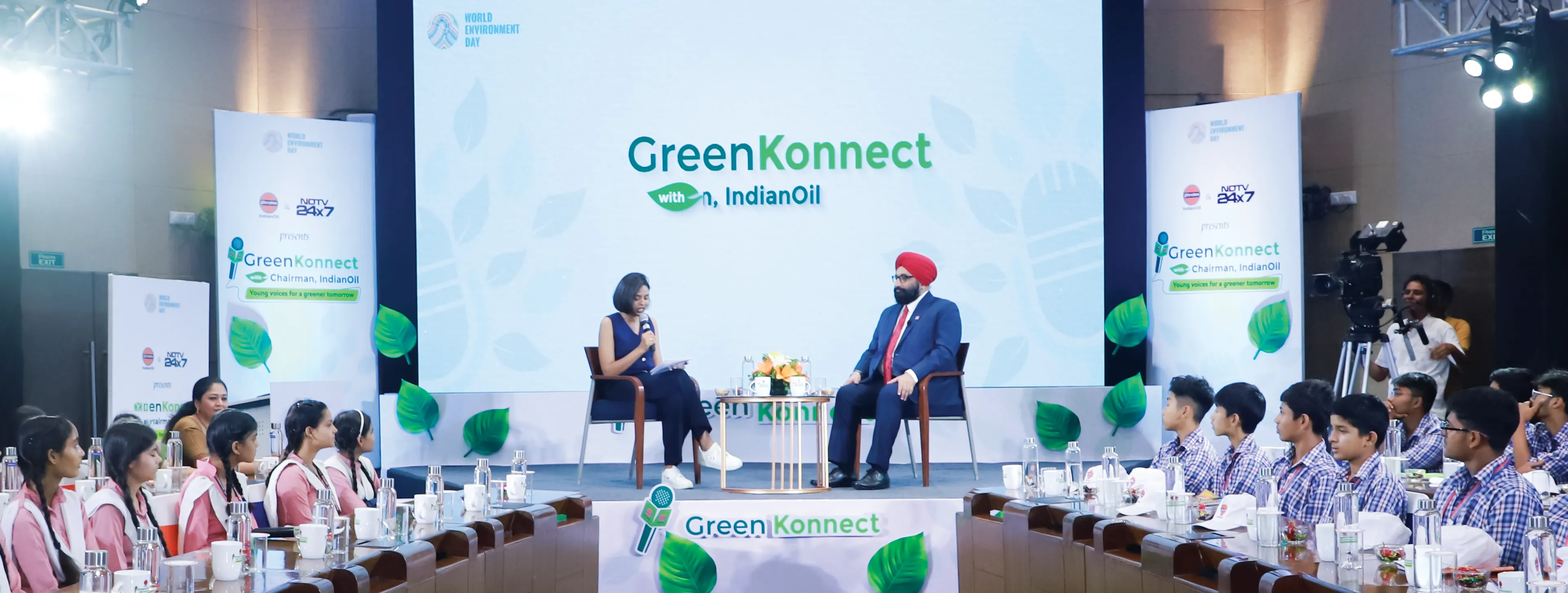
Green Konnect: Engaging with young minds for a sustainable future
DECARBONISATION AND ENERGY TRANSITION PATHWAY
We continued to strengthen our energy transition initiatives through investments in renewable energy, biofuels, green hydrogen and sustainable aviation fuel. Our approach remains focused on expanding lower-carbon energy pathways while enhancing operational reliability, energy efficiency and long-term business resilience across the value-chain.
Renewable Energy
Our renewable energy portfolio reached 258.06 MW during the year, comprising:
Renewable assets generated 371.40 GWh of electricity during the year, mitigating approximately 273.35 TMT of CO₂ emissions.
Round-the-clock Renewable Power
During 2025–26, the JV Company, IndianOil NTPC Green Energy Pvt. Ltd. (INGEL) continued progress towards meeting round-the-clock renewable power requirements for refinery expansion projects.
Solarisation of Retail Network
Expansion of solar infrastructure across the retail network continued during the year.
Compressed Biogas (CBG)
Biofuels continue to remain an important part of our lower-carbon fuel portfolio. During 2025–26, we continued expanding compressed biogas infrastructure and strengthening ethanol blending initiatives.
Compressed Biogas (CBG)
IOC GPS Renewables Pvt. Ltd., a Joint Venture Company, continued progressing 9 CBG projects across multiple states during the year. Municipal solid waste-based CBG initiatives also progressed through partnerships with Chandigarh Municipal Corporation and Nagar Nigam Gorakhpur.
Green Hydrogen and Sustainable Aviation Fuel
Development of future-ready fuel solutions continued during the year through initiatives across green hydrogen and sustainable aviation fuel.
Green Hydrogen
Construction commenced for India’s first large-scale Green Hydrogen Plant at Panipat Refinery, with planned capacity of 10 KTPA. The project is aligned with the National Green Hydrogen Mission and is being developed under a long-term supply arrangement framework.
Sustainable Aviation Fuel
Panipat Refinery became the first refinery in India to receive ISCC CORSIA certification for Sustainable Aviation Fuel (SAF). Plans also progressed for the development of a 100 KTPA HEFA-based SAF plant at Paradip Refinery through a proposed joint venture structure.
Emerging Energy Technologies
Our R&D ecosystem continued advancing
hydrogen-powered mobility solutions, fuel cell buses,
biomass-to-green hydrogen technologies,
and lower-carbon process innovations
through pilot demonstrations and technology development initiatives.
ENVIRONMENTAL STEWARDSHIP IN OPERATIONS
Management of energy, emissions, water and waste continues to form an important part of our operational approach across businesses. During the year, we continued to implement initiatives focused on process efficiency, resource optimisation and strengthening environmental performance. These efforts were supported through operational improvements, monitoring systems, cleaner technologies and infrastructure-led interventions across locations.
Energy Efficiency and Operational Optimisation
Improving energy performance and operational efficiency continued to be an important focus across our businesses. Operational improvement initiatives undertaken during supported energy savings, process optimisation and system reliability enhanced across refining and pipeline operations. Refineries recorded their best-ever Energy Intensity Index (EII) performance of 90.1 during the year. Fuel & Loss reduced to 8.46%, while operational availability across refineries reached 99.5%.
Energy conservation schemes resulted in energy savings of 4,14,126 Standard Refinery Fuel Tons (SRFT), equivalent to a monetary savings of ₹1,739 Crore.
Emissions Management
Reduction of operational emissions remained a key focus area across refining and downstream operations. Efforts during the year were directed towards cleaner fuel integration, process improvements and strengthening of emissions monitoring systems across operational locations.
Emissions Monitoring and Control
- ISO 14064 verification continued across refineries and petrochemical plants
- Real-time emissions and effluent monitoring systems operational across locations
- Monitoring systems integrated with CPCB/SPCB digital platforms
- Online Continuous Emission/ Effluent Monitoring Systems (OCEMS) infrastructure strengthened with automated alert mechanisms

Harnessing Solar Energy at Agatti AFS
Operational Initiatives
implemented at Barauni Refinery, resulted in approximately 90% reduction in VOC emissions from Effluent Treatment Plants.
commissioned with capacity of 4.27 MMSCMD at Haldia Refinery to support cleaner fuel usage across operations.
GHG Emissions (MMTCO₂e)
Expansion of cleaner mobility infrastructure continued during the financial year.
Water Stewardship
We continued to focus on improving water use efficiency across operations through wastewater reuse, rainwater harvesting and expansion of water reuse infrastructure. Our efforts remained focused on reducing freshwater consumption and increasing the use of treated water across operational locations.
Key Focus Areas
Expansion of treated wastewater utilisation
Reduction in freshwater usage
Strengthening of water reuse infrastructure
Rainwater harvesting and water conservation measures
Water neutrality assessments across operational locations
Treated Wastewater Utilisation
The use of treated wastewater across operations continued to increase as part of our efforts to improve water reuse and reduce dependence on freshwater sources. Sewage treatment infrastructure and reuse arrangements supported utilisation of recycled water for operational requirements, while additional wastewater reuse initiatives continued to progressed across identified locations.
At Haldia Refinery, we implemented an Integrated Wetland Technology-based Green STP, developed using IIT Bombay technology. The system enables treatment and reuse of sewage water for horticulture applications through a naturebased treatment process.
Waste Management and Circularity
We continued to strengthen waste management and circularity practices across operations through recovery, recycling, coprocessing and resource utilisation initiatives. Our efforts remained focused on reducing waste generation, improving material recovery and increasing resource reuse across operational processes.
Circularity and Resource Recovery Initiatives
IndEcoP2F
Technology demonstration for conversion of waste plastics into fuels within refinery systems.
DURAPAVEBIO
Development of indigenous bio-binder for sustainable road construction applications.
CYCLOPLAST
Promotion of sustainable material usage and polymer recyclates across applications.
BIODIVERSITY AND ECOLOGICAL RESPONSIBILITY
We continued strengthening biodiversity conservation and ecological restoration through afforestation, mangrove plantation and greenbelt development.
Key Biodiversity and Ecological Initiatives
- Mangroves 2.0 initiative progressed across 151 hectares in Purba Medinipur district, West Bengal
- Digital tree-tagging applications deployed for plantation monitoring and CO₂ accounting
We also continued ecological awareness initiatives during the year. A ‘Herbal Garden’ was developed at the R&D Centre to support conservation of medicinal plant species and promote biodiversity awareness. Nature-based initiatives continue to support our broader efforts towards environmental stewardship, operational resilience and long-term sustainability.
CLIMATE RISK AND LONG-TERM RESILIENCE
We continue to strengthen resilience across our infrastructure and operations through operational preparedness, technology integration and diversified energy pathways.
Strengthening Operational Resilience
Pipeline and logistics infrastructure continued operating with high reliability despite geopolitical disruptions and operational challenges during the year. ‘Proactive Contingency’ planning, ‘Round-the-clock’ monitoring systems and infrastructure optimisation supported uninterrupted operations across critical supply chains.
Operational Resilience Measures
Zero abnormal shutdowns across pipeline operations
Real-time operational monitoring systems
Remote supervision of critical activities through portable CCTV systems
Strengthened contingency response mechanisms
Digital Monitoring and Process Safety
We further strengthened environmental and operational risk management through centralised HSE dashboards, real-time emissions monitoring systems, Process Safety Management (PSM) frameworks, risk registers and API RP 754-aligned monitoring mechanisms, alongside while continuing to strengthen Management of Change (MoC) processes across operations.
Building Capability for Future Energy Systems
We continued strengthening organisational capability through:
- Hydrogen handling workshops
- Process safety programmes
- Sustainability-focused learning initiatives
- Environmental compliance training
- Operational risk management systems
Investments in renewable energy, green hydrogen, sustainable aviation fuel, compressed biogas, gas infrastructure, electric mobility and circularity initiatives strengthen preparedness for evolving energy and climate transition pathways.